
FAMPARC Search
Search this site
343 results found with an empty search
- Vale Patrick Emery
Vale Patrick Emery. The Board of the WIA offer their condolences to the family and friends on the passing of Patrick Emery from ACMA. A long time associate and friend of the WIA who has worked with many of the WIA volunteers for the betterment of Amateur Radio In Australia. We have received at the WIA in the past days the very sad news that Patrick Emery (Manager, Licensing Allocation Section) of the Australian Communications and Media Authority (ACMA), experienced a medical event on Christmas Eve and was subsequently diagnosed with an advanced brain tumour. He was rushed to Austin Hospital in Melbourne however, Patrick passed away peacefully surrounded by his beloved family. Our thoughts and condolences are with Patrick’s wife, two daughters, family, friends and colleagues at this tragic and very sad time. Patrick was 52 years of age, a qualified Lawyer and someone that at the WIA we respected tremendously. He has been instrumental in leading the recent consultations in class licensing and someone that we at the WIA considered very engaging, professionally competent and fair. Patrick was also a well-known music writer and published articles in The Australian, The Age and a range of other print media. I know the music industry are in shock with Patrick’s passing and of course at the WIA, we will miss him immensely.
- Working Broadcast. 91.1
Down the l radio station. SPIRIT FM. Rocking Hard www.ncradio.com.Au Peter VK3TQ.
- SPARC Bunnings Sausage Sizzle
SPARC Fund Raiser. Bunnings Sausage Sizzle This Saturday January 6th. 08:00am - onwards. Bunnings 282 Boneo Road Rosebud VIC 3939. Feel free to drop in and say Hello to SPARC Fund Raiser. Bunnings Sausage Sizzle and grab a Snag or drink if you're out doing some shopping. Hey Famparc Members... Would someone like to arrange this for our club ?
- YES IT WORKS!
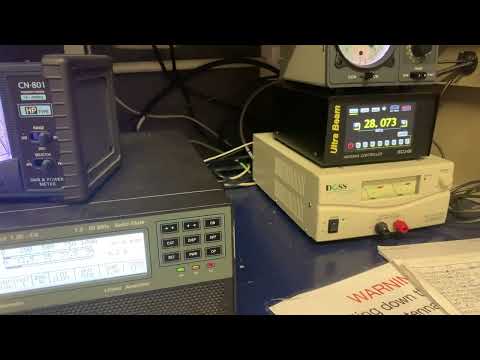
Hello Fellow Members, It has been my intentions to incorporate some Digital Modes to the clubs shack for all to use. There were thoughts that connecting another device via the USB connection on the back of the IC-7300 would upset the connection to both the Amplifier and the Ultrabeam systems. I thought that as well.. Well.. after lots of experimenting and also the help of Youtube, I have tested today the operation of my MacBook connected to the USB port on the IC-7300, and after configuring the radio so it will talk to the Laptop & without interrupting the other devices as above, I am very pleased to say that it worked without a hitch. Using bands such as 40M, 20M, 15M & 10M.. I was able to make contact with around 20 or so stations around the globe. So.. after all of that, I decided to power down the whole system, remove the Laptop and restart it all so to make sure that all normal operation was ok.. I am very pleased to say that all worked as per normal with no interruption to the Amp, Beam etc.. Here I a quick video of the setup working on FT8, using the WSJTX App. All we need is a nice fast PC or Laptop.. Your comments and thoughts will be appreciated. Craig vk3ncr
- Band Plan Updates Proposed
The WIA Technical Advisory Committee – Band Plan Updates Proposed for 6m, 70cm and 9cm bands Date : 21 / 12 / 2023Author : Grant Willis VK5GR The Wireless Institute of Australia - Technical Advisory Committee are proposing changes to the Band Plan for 6m, 70cm and 9cm bands The WIA TAC has opened a new band planning consultation paper for comment. Changes are being considered to the following bands: •6m- with the AOCP(S) Standard class licensees gaining access to the entire band, a proposal has been made to remove the weak signal segment between 52.0 and 52.5 MHz and replace it with a new wideband segment, in support of new experiments including Reduced Bandwidth ATV using digital modulation techniques. •70cm- it is proposed to remove the grand fathered repeater segments and add an additional segment between 439.625-439.7875 which is allowed to use -7 MHz offset. In addition, the repeaters between 439.800-440.000 are also proposed to be granted access to -7MHz receiver offsets should the repeater operator wish to use them. •9cm- with the withdrawal of much of the amateur allocation between 3400-3600 MHz, as well as reports of interference and overload challenges with the weak signal segment currently being placed directly adjacent the 3400 -3420 MHz NBN LTE transmitters, a review of the band is proposed. Options are discussed and a new channel plan for wideband is also proposed. The full consultation paper is available here:Link We invite all radio amateurs to download and consider the proposals. Feedback is most welcome and can be forwarded to us on email at tac@wia.org.au. We are leaving the submission period open until January 31st 2024. Please take the time to review the proposals and contribute your feedback. Regards, Grant Willis VK5GR WIA TAC Chairman Page Last Updated: Saturday, 23 Dec 2023 at 18:26 hours by Peter Clee NOTE: Comment for Standard License Holders.. 6m (50 – 54 MHz) Band Proposed Narrow Band Mode Segment Changes Now that both AOCP(A) and AOCP(S) grade operators can access the whole band, the need to retain two narrow band mode segments has been made redundant.
- NEW IDEAS FOR 2024
Happy New Year to All!! I have created a new Category within our Forum for all to be a part of. NEW IDEAS For FAMPARC. So join in and add your ideas so we can continue to grow the our club. Simply Click the Button below which will take you to our Club Forum Page, then Select New Ideas For Famparc Category and then get busy and add your ideas..
- A NEW BABY UPDATE
Hello Famparc Members, We are proud to announce the club has a new addition to the Radio Shack. It's the sister radio to the clubs Icom IC-7300, the IC-9700. 144, 430/440, and 1200 MHz All Mode Transceiver Including Satellite, DV, and DD Modes The IC-9700 is an all mode Tri-band transceiver, covering 2 m, 70 cm, and 23 cm. In addition to the traditional SSB, AM, FM, CW, and RTTY modes, the transceiver also incorporates D-STAR (Digital Smart Technology for Amateur Radio) DV and DD modes. A full featured Satellite mode is built-in! There are three antenna connectors, one each for 144, 430/440, and 1200 MHz. RF Direct Sampling, for 144 MHz and 430/440 MHz, is utilized in the IC-9700. For 1200 MHz, the Down Conversion IF Sampling method is adopted. In this system, signals are digitized by the ADC and processed in the FPGA. The signals are processed in the digital domain, thus eliminating distortion and other nonlinear elements seen in the legacy superheterodyne receivers. The outcome is that the signal purity is very high, and clear audio can be generated. D-STAR Operation Friendly Functions The IC-9700 has the D-STAR Repeater (DR) function that has been well received by D-STAR enthusiasts. The DR function can be used on both the Main and Sub bands simultaneously to listen to two separate DV signals. Moreover, by using the DD mode, you can browse the Internet through a repeater station. D-STAR System Introduction As well as many more features... CLICK HERE UPDATE 30th Dec, 2023 With help from Terry VK3BMX, the new IC-9700 now has lots of memory stations for FM Repeaters and D-Star Repeaters. I also have exchanged an antenna for a Tri-Band Antenna (2M, 70cm, 23cm). We are still awaiting delivery of the Triplexer for the new Antenna. We are currently using only the 2M/70cm band Antenna that is at the front of the club rooms. So it is fully operational on those bands. The Digital side (D-Star) is working a treat, and many local and overseas stations have been worked by this amazing system. So.. feel free to use the radio, however I would suggest if you are unfamiliar with the operation that you ask someone at the club who is. You will be more than welcome to use it.. that's what the shack is for.
- D-STAR QSO PARTY 2023 - 2024
D-STAR QSO PARTY 2023 October 20th, 2023 ◆ Purpose Encourage use of D-STAR protocol in RF and IP around the globe as well as the picture sending functions available for newer generation D-STAR radios ◆ Rules The goal of the D-STAR QSO PARTY is to increase use of D-STAR communications in direct, via a repeater / repeaters as well as any Internet relayed voice communication means using D-STAR protocol. Exchanging pictures in a data mode will gain the highest points. All the operators who submit an approved log will be given a Party Certificate (PDF file). Operators who submit an approved log with at least 30 points worth of communications will be eligible for the prize draw. Winners will be randomly selected to each win a prize. The more D-STAR QSO’s you make, the more chances you have to win. Please refer to the entry QSO point rules below. QSO Points 10 points 5 points : Exchange pictures by D-STAR data mode in addition to voice communication: Direct, via a D-STAR repeater or D-STAR repeaters (Callsign routing) voice communication between D-STAR radios: Any other means between any devices using D-STAR protocol either in IP or RF (including use of 1 pointNote: QSO between the same station can be counted only once in a day. reflectors / internet relayed non-radio terminals) ➢ To quality for prize draw point, you need to successfully make contacts which total points are at least 30.➢ Every more 30points up to 210 will gain another draw right (30points = 1, 60points = 2, 90points = 3 / Max 7 rights).➢ Please refer to the event site and product manuals about picture exchange If you made D-STAR communications worth 65 points, you will have the two draw rights (double the chance of winning a prize than single draw right). ◆ How the above “prize draw right” system will work ➢ The name and/or call sign of each valid entrant into the D-STAR QSO PARTY will be collated and included in ➢ As per the explanation above, the number of prize draw right is multiplied depending on the points of result of ➢ Winners can receive only one prize. Therefore, in the case where a winner’s name/call sign is drawn again, D-STAR QSO Party 2023 details ◆ Date & timeUTC: December 27th, 2023 0:00 – January 5th, 2024 23:59 ◆ QSO Party organizerIcom Incorporated / Icom America Inc. ◆ Who can take part in the QSO party? All licensed Ham Radio operators. ◆ Participation bands and modes No restrictions (D-STAR protocol) ◆ Making a call “CQ D-STAR QSO PARTY 2023” ➢ The other stations RS➢ The radio or device name you used for the communication Example of rubber stamp QSO :<>CQ D-STAR QSO PARTY,CQ D-STAR QSO PARTY.This is JA3YUA,Juliett - Alfa - Three - Yankee - Uniform - Alfa,JA3YUA. From Hirano Repeater to Seattle Repeater. Calling CQ and Standing-by. <JA3YUA, This is N9JA, November - Nine - Juliet – Alfa From Seattle Repeater to Hirano Repeater. I am from the U.S. (country name)Exchange Number is “59” and “ID-52” Over <>N9JA, This is JA3YUA,Juliett - Alfa - Three - Yankee - Uniform - Alfa,JA3YUA. Thank you for coming back my call.I am from Japan.Exchange Number is “59” and “IC-9700” 73 <>You may additionally exchange pictures showing callsign as proof of picture QSO (i.e. digital QSO card like picture) in any D-STAR data mode (slow / fast data). ◆ Things to remember Abide by all Amateur Radio laws in your country. Party organizers are not responsible for any direct or indirect damage/trouble associated with this D-STAR When you use the repeaters, be considerate of other users who are not taking part in this QSO party. ◆ How to submit a logThere are two log formats accepted. Please use the supplied spread sheet files and submit it to the e-mail address listed below. Please make the name of the file your call sign. For example: JA3YUA.log.xls When a communication is accompanied with picture exchange, please supply the file (JPEG or PNG which size is less than 1MB each / use radio’s and/or smart device application screen shot function) together with the record. The file name of such pictures must include the callsign. You can download a summary sheet and log sheet from “Log Reporting” page listed below and submit the completed sheets by E-mail In addition to that, you can prepare your own log in an Excel spreadsheet. The same above-mentioned picture rule is applicable also for Paper submission. ◆ Due date for submitting (must arrive by date) January 21st, 2024 23:59 UTC ◆ Where to sendE-mail : D-Star.QSOPARTY_LOG@IcomAmerica.com ◆ Double check the following before submitting.1. Please fill in your name and call sign, in the comment column.2. Please fill in the model name of the radio or device you used for this QSO party.3. Please fill in your comments regarding the QSO party after participation, and share your ideas. 4. Please understand that winning call signs will be published when the winners are announced. ◆ JudgeIcom Incorporated / Icom America Inc. ◆ Prizes30 x Limited special D-STAR QSO Party Plaque ◆ Disqualification1. Participants who do not obey the relevant Amateur Radio laws of their country.2. Participants who do not obey the QSO party rules.3. Participants who submit false logs4. Participants who submit insufficient documents or send logs by normal mail at short paid. 5. Participants who are disqualified by the QSO party organizers for any other valid reason. ◆ Announcement of resultsResults will be announced on February 29th, 2024 ◆ Comments or inquiriesComments or inquiries will be accepted by e-mail until January 21st, 2024 23:59 UTC D-Star.QSOPARTY_QUESTIONS@IcomAmerica.com ◆ NotificationThe two e-mail addresses below, for correspondence regarding this D-STAR QSO party, will become invalid on February 29th, 2024.E-mail address to submit logs : D-Star.QSOPARTY_LOG@IcomAmerica.comE-mail address for comments/inquiries : D-Star.QSOPARTY_QUESTIONS@IcomAmerica.com
- AMAZING NOISE REDUCTION
Richard, VK3TXD just sent me this link on a Youtube clip showing a way to help and assist Amateur's that are having massive noise problems. Thanks Richard... Great demo from this chap. How to MASSIVELY Reduce Your Noise level on SSB & CW.....For Free
- HELP FOR NEWBIES
Hello Members, Found this video that may be of assistance to new Hams.. Just remember, prices are not in Australian Dollars as well as measurements. Also.. FAMPARC have a available UNUN Kits for use with End Fed Half Wave Antennas.
- ADDITION TO THE CLUB
Thanks to Peter, VK3DEL, for donating to the club of this amazing data feed for Amateur Radio. App Name: HamClock for Raspberry PI. The App runs on a Raspberry PI and is connected to our clubs TV.. The App shows a variety of information related to Amateur Radio, such as UTC time, Sun Spots, DX Spots and much more.. The App cycles through other information. Another great additon to the club.. Thanks Peter!
- MEMBERSHIP FEES
Hello Members, Just a reminder that Famparc Membership fees for 2024 are due by Jan 1st 2024. Remember that these fees help the club continue to grow allowing members to enjoy the benefits of a great Amateur Radio Club. So please remember to pay your Membership Fees. The club after many years have voted recently to increase the fees (See Below) for 2024. However, you can still pay the 2023 charges for your 2024 membership. This is a small saving but a saving nonetheless. Normal $45.00, Student/Pensioner/Retired $40.00, Family $50.00. 2024 Fees as of Jan 1st 2024. Normal $50.00 Student/Pensioner/Retired $45.00 Family $55.00 Our bankers are NAB, Frankston BSB: 083-253 Acct No: 03-683-3688 Please make contact with Colin VK3CR regarding payment.